
Description
Introduction to Sudoku
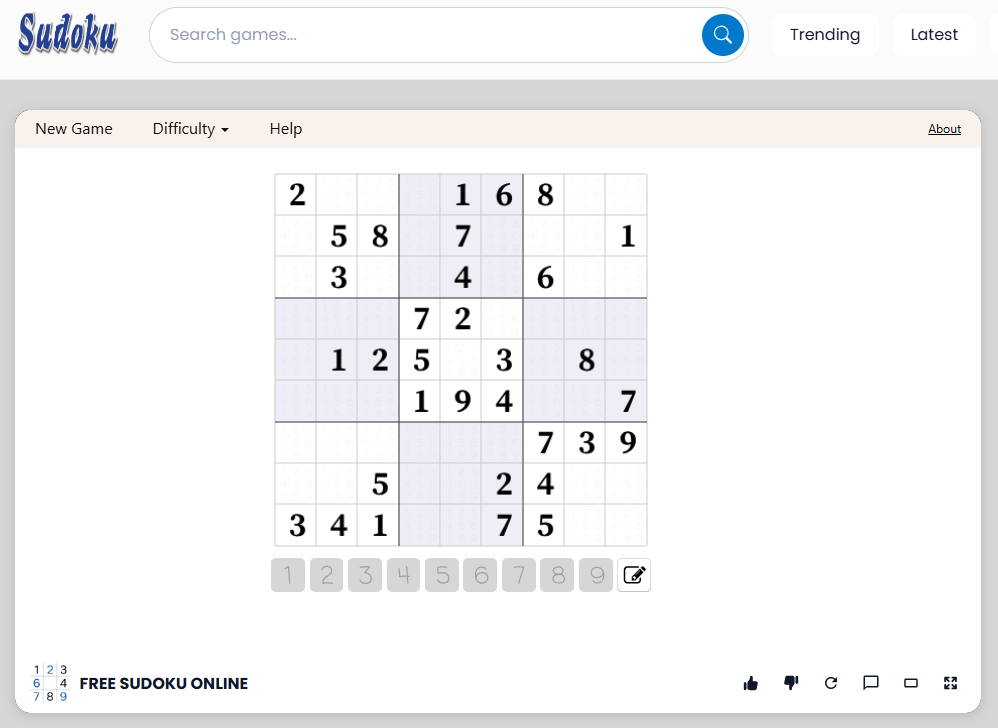
Sudoku is one of the most popular logic puzzles in the world. Millions of players enjoy Sudoku every day because it combines entertainment, concentration, and mental exercise in a simple format. A standard Sudoku puzzle contains a 9x9 grid divided into nine smaller 3x3 sections. The goal is to fill every empty cell with numbers from 1 to 9 while following a set of logical rules.
Unlike many number-based games, Sudoku does not require mathematical calculations. Success depends on observation, deduction, and pattern recognition. This unique characteristic makes Sudoku suitable for people of all ages, from students looking to improve focus to adults searching for a relaxing mental challenge.
What Makes Sudoku So Popular?
Sudoku has gained worldwide recognition due to its accessibility and engaging gameplay. The rules are easy to understand, yet puzzles can range from very simple to extremely difficult.
Easy Rules for Everyone
A Sudoku puzzle follows three basic rules. Each row must contain numbers from 1 to 9 without repetition. Each column must also contain numbers from 1 to 9 without repetition. Every 3x3 section must include all numbers from 1 to 9 exactly once.
These straightforward rules allow beginners to start playing within minutes. At the same time, advanced puzzles provide a significant challenge for experienced players.
A Perfect Balance of Simplicity and Depth
The beauty of Sudoku comes from the balance between simple mechanics and deep logical thinking. Every move influences multiple areas of the grid, creating an engaging puzzle-solving experience. Players often feel rewarded when a difficult puzzle gradually reveals a complete solution.
History and Development of Sudoku
Although Sudoku became famous during recent decades, the concept originated from earlier number puzzles. Modern Sudoku evolved through several stages before reaching global popularity.
Early Foundations
Number placement puzzles appeared in newspapers and puzzle collections long before the modern version of Sudoku. These early puzzles focused on arranging numbers according to specific patterns and restrictions.
Global Expansion
The modern Sudoku format gained significant attention in Japan, where the puzzle received the name Sudoku. The term can be translated as the idea that numbers should appear only once within designated areas. From Japan, Sudoku spread to newspapers, magazines, websites, and mobile applications around the world.
Today, Sudoku remains a staple of puzzle culture and continues to attract new players every year.
Benefits of Playing Sudoku
Sudoku offers much more than simple entertainment. Regular practice can provide several cognitive and emotional benefits.
Improved Concentration
Solving Sudoku requires careful attention to detail. Players must analyze rows, columns, and sections simultaneously. This process strengthens focus and encourages sustained concentration.
Enhanced Logical Thinking
Every Sudoku puzzle relies on logical deduction rather than guessing. Players learn to evaluate possibilities, eliminate incorrect options, and identify patterns. These skills can support problem-solving abilities in everyday situations.
Mental Relaxation
Many people use Sudoku as a way to relax after a busy day. The puzzle demands enough attention to distract from stress while remaining structured and predictable. This combination creates a calming experience for many players.
Better Memory Function
Regular Sudoku practice encourages active use of working memory. Players often need to remember possible number placements while examining other areas of the grid. This mental activity helps keep the brain engaged and alert.
Strategies for Solving Sudoku Efficiently
Many beginners believe Sudoku depends on luck. In reality, successful solving comes from applying logical techniques and consistent strategies.
Start With Obvious Numbers
The first step is identifying rows, columns, or sections that already contain many numbers. These areas often reveal easy placements because fewer possibilities remain.
When a row is missing only one number, the correct answer can usually be determined immediately. Filling these obvious positions creates momentum and opens new opportunities elsewhere in the puzzle.
Use the Elimination Method
The elimination method involves examining all possible numbers for an empty cell. By comparing the row, column, and section, players can remove numbers that already exist nearby.
As possibilities decrease, the correct number becomes easier to identify. This method serves as one of the most important Sudoku techniques.
Look for Hidden Patterns
More advanced puzzles often require pattern recognition. Certain arrangements of numbers can reveal unique solutions even when direct elimination appears insufficient.
Experienced players learn to identify recurring structures that simplify difficult sections of the grid.
Different Types of Sudoku
The popularity of Sudoku has inspired numerous variations. These alternative formats introduce new rules and challenges while preserving the core concept.
Mini Sudoku
Mini Sudoku uses smaller grids, making puzzles quicker to complete. This format is ideal for beginners or players with limited time.
Killer Sudoku
Killer Sudoku combines traditional Sudoku rules with additional numerical constraints. Specific groups of cells must add up to designated totals, creating a more complex challenge.
Samurai Sudoku
Samurai Sudoku features multiple overlapping grids connected in a larger puzzle structure. This variation demands greater planning and advanced logical reasoning.
Hyper Sudoku
Hyper Sudoku introduces extra regions that must also contain numbers from 1 to 9 without repetition. These additional restrictions increase puzzle complexity.
Why Sudoku Remains Relevant Today
Despite the growth of video games and digital entertainment, Sudoku continues to thrive. Modern technology has made Sudoku more accessible than ever through websites, smartphone applications, and online competitions.
Many people appreciate Sudoku because it provides meaningful mental engagement without requiring expensive equipment or extensive preparation. A single puzzle can deliver minutes or even hours of satisfying problem-solving.
Educational institutions, workplaces, and wellness programs also recognize the value of logical puzzles. Sudoku often appears as a recommended activity for maintaining mental sharpness and encouraging critical thinking.
Conclusion
Sudoku remains one of the most engaging logic puzzles available today. Simple rules, challenging gameplay, and significant mental benefits contribute to lasting popularity across different age groups. Whether solving an easy puzzle during a short break or tackling an advanced challenge over several hours, Sudoku offers a rewarding experience that strengthens concentration, logic, and persistence.
For anyone seeking a combination of entertainment and brain training, Sudoku continues to stand as an excellent choice. Regular practice can improve problem-solving skills while providing an enjoyable and relaxing activity suitable for everyday life.
Location
-
United States
Primary care dentistry
Specialty dentistry
Restorative dentistry
Education & Training Info
- Institution Location: New York, NY, USA




Add a review